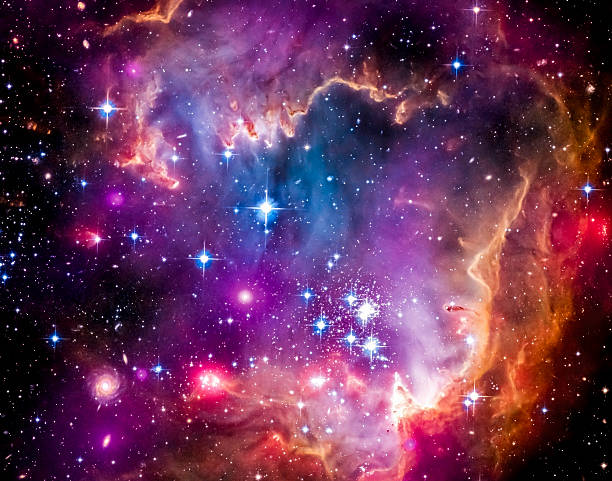
Exploring Dark Matter: The Invisible Force Shaping Our Universe
In the quest to understand the cosmos, dark matter emerges as one of the most intriguing phenomena in modern astrophysics. While it makes up approximately 27% of the universe's total mass-energy content, dark matter remains elusive, as it does not emit, absorb, or reflect any electromagnetic radiation. This invisibility leads scientists to infer its existence primarily through gravitational effects on visible matter, such as galaxies and galaxy clusters. For instance, the rotation curves of galaxies suggest that there is more mass present than what we can observe. As researchers continue to explore this invisible force, they utilize a combination of observational data and sophisticated simulations to better understand its role in cosmic evolution.
Understanding dark matter is crucial, as it plays a vital role in the formation and structure of the universe. Numerous theories have emerged regarding its composition, ranging from weakly interacting massive particles (WIMPs) to axions. Upcoming experiments and astronomical observations aim to uncover more about this mysterious substance. Furthermore, the impact of dark matter extends beyond mere conjecture; it influences the formation of galaxies and the distribution of cosmic structures. As we delve deeper into the fabric of the universe, unraveling the mysteries of dark matter could change our fundamental understanding of physics and the very nature of reality.
Counter-Strike is one of the most iconic first-person shooter games that has captivated players around the world for decades. Its competitive gameplay and team-based mechanics have led to a thriving esports scene. For those looking to enhance their gaming experience, check out the Top 10 Samsung Galaxy Accessories that can elevate your mobile gaming setup.
The Mysteries of Exoplanets: Could We Find Another Earth?
The search for exoplanets — planets that exist outside our solar system — has captivated scientists and enthusiasts alike. With advancements in telescope technology and observational techniques, we are now able to detect these distant worlds, leading to an explosion of discoveries. As of now, astronomers have identified over 5,000 confirmed exoplanets, with many more candidates awaiting verification. But the real question remains: could some of these exoplanets resemble Earth closely enough to support life? Explorations of exoplanets often focus on the 'Goldilocks zone,' where conditions are just right for liquid water to exist, a crucial ingredient for life as we know it.
In the quest to find another Earth, researchers are employing innovative methods to analyze the atmospheres and chemical compositions of these alien worlds. Instruments like the James Webb Space Telescope are at the forefront, offering unprecedented views of exoplanet atmospheres that might hint at the potential for life. Such *atmospheric studies* could reveal essential biosignatures, such as oxygen or methane, which are often associated with biological processes. The journey to uncover the mysteries of exoplanets is just beginning, and as technology continues to evolve, the dream of finding another Earth becomes increasingly tangible.
What Lies Beyond the Observable Universe?
The observable universe is a fascinating concept, representing the portion of the entire universe that we can see or detect through our telescopes and instruments. However, the question arises: what lies beyond the observable universe? Scientists speculate that beyond this horizon, there could be vast regions of space that extend infinitely, containing galaxies, stars, and potentially even more dimensions of reality that we are currently unable to perceive. These areas are not just empty voids; they may adhere to similar physical laws as those observed within the visible universe, yet their study remains enigmatic due to the limits imposed by the speed of light and our current observational technologies.
Many cosmologists propose that beyond the observable universe, one could encounter a multiverse—an expansive collection of other universes with different physical constants and laws. This theory posits that while our universe has its unique properties, there could be countless others that differ radically from ours. To illustrate this, consider the various possible outcomes of quantum events, leading to alternate realities in a vast cosmic tapestry. Understanding what lies beyond the observable universe may one day reveal answers to some of the most profound questions about existence, the nature of reality, and even the origins of the cosmos itself.